The 21st century World's three biggest groups of fools are smokers, people who do not know about music, and people who do not know about computers, according to North Korea's leader Kim Jong-Il.
Source: Article on Politiken.dk
Wednesday, 21 December 2005


Tuesday, 20 December 2005
Saturday, 17 December 2005
Thursday, 15 December 2005
Homo consumentis
«[J]e haïssais cette société, cette période, j'étais très deçu par ce que le monde attendait de moi, [...] comme homme, la façon dont la société me demandait de me comporter : seulement en consommateur.»
Bret Easton Ellis sur l'existence qu'il menait à New York à l'époque où il écrivait «American Psycho» (publié 1991)
Bret Easton Ellis sur l'existence qu'il menait à New York à l'époque où il écrivait «American Psycho» (publié 1991)
Source: interview dans les Inrockuptibles
Wednesday, 14 December 2005
| Your Seduction Style: Au Natural |
 You rank up there with your seduction skills, though you might not know it. That's because you're a natural at seduction. You don't realize your power! The root of your natural seduction power: your innocence and optimism. You're the type of person who happily plays around and creates a unique little world. Little do you know that your personal paradise is so appealing that it sucks people in. You find joy in everything - so is it any surprise that people find joy in you? You bring back the inner child in everyone you meet with your sincere and spontaneous ways. Your childlike (but not childish) behavior also inspires others to care for you. As a result, those who you befriend and date tend to be incredibly loyal to you. |
Tuesday, 13 December 2005

Monday, 12 December 2005

Sunday, 11 December 2005

Friday, 9 December 2005
L'amour est la liberté
«C'est si merveilleux d'aimer sans exiger rien de l'autre. [...]
L'amour est donc la liberté.»
Jiddu Krishnamurti
L'amour est donc la liberté.»
Jiddu Krishnamurti
12 février 1982, entretien avec le Pr Maurice Wilkins à Brockwood Park, Bramdean, Hampshire, UK. Source: «De l'amour et de la solitude» (livredepoche.com) traduit par Colette Joyeux; titre original «On Love And Loneliness» (Harper's San Francisco) ― Unfortunately I cannot find the original quotation in English on The Net.
Thursday, 8 December 2005

Tuesday, 6 December 2005
The beauty of love
'The beauty of love is that you never know when it hits. Or comes sneaking. All you need is an open mind towards it. 'Cause you can't protect yourself against it anyway, so why waste your energy and wrap yourself into a numb being that you do not wish to be!?! Love is a gift, and we get more chances than we dare to admit. We tend to only see the pain afterwards but fact is we cannot escape, and if we do, we most likely end up being even more hurt. Call me naive for all I care; I have chosen to see The World this way, for the alternative(s) seem like choosing to die rather than live.'
Bjørn Clasen
Bjørn Clasen
Sunday, 4 December 2005

Tuesday, 29 November 2005
The simple truth about information
'Information is only useful when it can be understood.'
Muriel Cooper
Muriel Cooper
Seen in the Design Museum.
Friday, 25 November 2005
Den Eneste Ene...
'Man er konstant på jagt efter den eneste ene,
også når man tror, at man allerede har fundet den...'
Steffen Brandt
også når man tror, at man allerede har fundet den...'
Steffen Brandt
Kilde: Mere tv-2 om lidt...
Curtains or blinds?
Ode to a curtain
You are so beautiful and so tall,
protecting me from the outside invaders,
You hide me from the darkness,
and when I open the balcony door
you can dance with the wind.
I like your soft touch and
smooth look.
And when I feel sad I can wrap
myself into you and hide from the rest of
the world.
Anti-ode to the blinds
You rattle like the old men's teeth,
disharmony for my ears,
even the colour you are wrapped in became
pale when she came into touch with you,
when I touch you you are cold and life has
left you long ago.
You fight with the wind and
the darkness can still peep into my room
through your imperfect structure.
Milena Zuran 17/11-5
You are so beautiful and so tall,
protecting me from the outside invaders,
You hide me from the darkness,
and when I open the balcony door
you can dance with the wind.
I like your soft touch and
smooth look.
And when I feel sad I can wrap
myself into you and hide from the rest of
the world.
Anti-ode to the blinds
You rattle like the old men's teeth,
disharmony for my ears,
even the colour you are wrapped in became
pale when she came into touch with you,
when I touch you you are cold and life has
left you long ago.
You fight with the wind and
the darkness can still peep into my room
through your imperfect structure.
Milena Zuran 17/11-5
Sunday, 20 November 2005
The 100th post!
I thought I'd make some statistics in order to see what kinda stuff my blog actually contains. As it often happens when one tries to categorise, put things in limited, generalising boxes, I found no 'good' way of structuring the thing. Luckily, I'd say ― 'cause I guess this shows that my blog enjoys a great deal of diversity, which to me is a stamp of quality.
Just to get a vague idea, however, I've chosen to add it all up into far broader themes (when counting, I reached 32! And with a lot of borderline cases and overlaps). Happy Hundredth!
Themes
Culture: 30 posts
Politics: 19 posts
Personal: 16 posts
Philosophy: 12 posts
Science: 8 posts
Love (& Sex): 7 posts
(Other) fun: 4 posts
Travel: 3 posts
plus this post
Bjørn's Multilingual Blog contains posts in 11 different languages ― 9 posts are in more than one language ― though Luxembourgish and Dutch are not included so far.
Languages
English: 49 posts
Danish: 36 posts
German: 9 posts
French: 7 posts
Castellano: 2 posts
Swedish: 2 posts
Kölsch: 1 post
Latin: 1 post
Norwegian: 1 post
Polish: 1 post
Turkish: 1 post
I launched the blog on 7 January 2004. That is 684 days ago today, meaning that on average there is one post a week. The most active month has been September 2005 (11 posts), whereas August 2004 and December 2004 saw only one post each.
Some rediscovered highlights
The meaning of life
Shoe Souls
L'obligation d'un éditeur public
I believe (Insomnia Gallery)
Deutsche Schimpfwörter
Saturday, 22 October 2005

Monday, 17 October 2005
Thursday, 13 October 2005

Sunday, 9 October 2005
Yes ― That's Me
| Your World View |
You strongly reject traditional values. Above everything else, you value honesty. For you, morality and truth are one and the same. You hate to be thought of as weak or insecure. You abhor hypocrisy and have troubles with authority. You are impulsive and somewhat unpredictable. |
Friday, 7 October 2005
Wise words from Václav
'The new European democracies that have emerged from the ruins of the Communist world are seeking membership in the European Union. Some have a chance of joining it sooner, others may become ready later on, but the process is bound to be long and arduous for all of them. It is not easy to make up for fifty years' delay. Nevertheless, it is evidently in the interests of the whole of Europe that these countries should progress towards membership in the Union, which has been a cornerstone of European integration. Throughout history, the price for any division of Europe has ultimately been paid by the whole continent. It follows that its unification is essential to the interests of all European countries.'
Václav Havel, 27 April 1995
Václav Havel, 27 April 1995
Saturday, 24 September 2005
Studying to legitimise
'[W]hy am I studying? Well, the control of the legitimate power is so strong, that to adopt to the system of 'civilised' I force myself to do things, which the powerful require. Like this small studying of mine is actually a sign of capitalism having turned me into a portfolio-person. By training myself to survive better in the system I actually legitimise the system. Brilliant.'
Kirsi Tanski
De polske aner
Min farmors mor Johanne Emma Nitschke blev født den 11. november 1877 i Śląsk/Schlesien, nærmere betegnet i Nieder Herwigsdorf, som nu hedder Stypołów, en lille by ca. 100 km nordvest for Wrocław og vel en 20-30 km fra Polens nuværende grænse til Tyskland. Sognebyen var Freystadt (nu Kożuchów), den nærmeste større by Żagan, hvis tyske navn jeg ikke kan finde og min far ikke kan huske.
Emmas mor hed Johanne Rosina Schorsch. Faderen Reinhold var snedker. Familien flyttede til Berlin, inden Emma begyndte sin skolegang.
Emmas mor hed Johanne Rosina Schorsch. Faderen Reinhold var snedker. Familien flyttede til Berlin, inden Emma begyndte sin skolegang.
How many countries we've been to
A few months ago, we were a group of friends discussing travelling. The eternal subject came up: Who has been where. And man's weakness for numbers ignited the below list.
A such debate also causes discussions as to what is to be considered as a country. For example, Koen wanted Carpetland, Disneyland and heel veel Weiland to be taken into account but rejected Christophe's Plopsaland suggestion. And what about countries you have not actually been to but looked into across the border or in the horizon ― Christophe mentioned Algeria and Saudi Arabia; Bjørn mentioned Bolivia, Paraguay and the Soviet Union, the latter he has even 'seen' both from Finland and Norway)?
The list counts only countries one has physically been to, and at least overnight. This eliminates Monaco, San Marino, the Vatican, and even Hong Kong and Switzerland from some people's list. As for what to consider as a separate country, it's a little more fuzzy. Places with a certain degree of independency such as Denmark's dependencies, the Acores, Sint-Maarten and even French Guyana have been counted, but not Rapa Nui/Easter Island or Zanzibar, as these have no particular autonomy and are geographically somehow connected to their ruling country. [Due to several comments on the Acores, it was after all not counted as a country.] Moreover, the UK is considered just one country though there are differennces between the 'competitors' as to how many of the lands they have been to.
A such debate also causes discussions as to what is to be considered as a country. For example, Koen wanted Carpetland, Disneyland and heel veel Weiland to be taken into account but rejected Christophe's Plopsaland suggestion. And what about countries you have not actually been to but looked into across the border or in the horizon ― Christophe mentioned Algeria and Saudi Arabia; Bjørn mentioned Bolivia, Paraguay and the Soviet Union, the latter he has even 'seen' both from Finland and Norway)?
The list counts only countries one has physically been to, and at least overnight. This eliminates Monaco, San Marino, the Vatican, and even Hong Kong and Switzerland from some people's list. As for what to consider as a separate country, it's a little more fuzzy. Places with a certain degree of independency such as Denmark's dependencies, the Acores, Sint-Maarten and even French Guyana have been counted, but not Rapa Nui/Easter Island or Zanzibar, as these have no particular autonomy and are geographically somehow connected to their ruling country. [Due to several comments on the Acores, it was after all not counted as a country.] Moreover, the UK is considered just one country though there are differennces between the 'competitors' as to how many of the lands they have been to.
Europe
Andorra Christophe
Austria Kris - Noëlle - Christophe - Koen - Bjørn
Belgium Kris - Noëlle - Christophe - Koen - Bjørn
Croatia Christophe - Koen
Cyprus Kris
Czech Republic (or the Czech part of Czechoslovakia) Kris - Noëlle - Christophe - Bjørn
Denmark Noëlle - Christophe - Bjørn
Estonia Noëlle - Bjørn
Faroe Islands Noëlle - Bjørn
Finland Noëlle - Bjørn
France Kris - Noëlle - Christophe - Koen - Bjørn
Germany Kris - Noëlle - Christophe - Koen - Bjørn
Greece Kris - Noëlle - Christophe - Koen
Hungary Christophe - Bjørn
Iceland Noëlle - Bjørn
Ireland Christophe - Bjørn
Italy Kris - Noëlle - Christophe - Koen - Bjørn
Latvia Noëlle - Bjørn
Lithuania Noëlle - Bjørn
Luxembourg Kris - Noëlle - Christophe - Koen - Bjørn
The Netherlands Kris - Noëlle - Christophe - Koen - Bjørn
Norway Noëlle - Bjørn
Poland Bjørn
Portugal Kris - Noëlle - Christophe - Bjørn
Slovakia Koen
Slovenia Noëlle - Christophe - Bjørn
Spain Kris - Noëlle - Christophe - Koen - Bjørn
Sweden Noëlle - Christophe - Bjørn
Switzerland Noëlle - Koen
United Kingdom Kris - Noëlle - Christophe - Koen - Bjørn
Africa
Morocco Kris - Noëlle
South Africa Koen
Tanzania Kris
Tunisia Noëlle - Christophe - Koen
North America
Bahamas Koen
Canada Kris - Noëlle - Koen
Cuba Kris
Dominican Republic Kris - Christophe
Greenland Bjørn
Mexico Noëlle
Sint-Maarten Kris
USA Noëlle - Koen
South America
Argentina Noëlle - Bjørn
Brazil Noëlle - Bjørn
Chile Noëlle - Bjørn
Ecuador Kris
French Guyana Kris
Surinam Kris
Asia
Israel Christophe
Jordan Christophe - Koen
Thailand Kris
Turkey Kris - Noëlle - Christophe - Koen
Oceania
Australia Koen
New Zealand Noëlle - Bjørn
Total (countries/continents)
Noëlle 33/6
Bjørn 29/4
Kris 24/5
Christophe 24/4
Koen 21/5
Friday, 23 September 2005
Poèmalade
Je suis frigorifiée, j'ai mal partout.
Je rentre chez moi.
La salle 481 m'a tuée.
@+
Marie-Claire
Je rentre chez moi.
La salle 481 m'a tuée.
@+
Marie-Claire
Wednesday, 21 September 2005
Tintin hedder Tintin, Haddock hedder Haddock, og Bjævermose hedder så… Bjævermose
PRESSEMEDDELELSE - København, den 20. september 2005
Som allerede annonceret i starten af måneden genudgiver Forlaget Carlsen hele Hergés klassiske tegneserie Tintins Oplevelser. Der er tale om et storstilet projekt med helt nye oversættelser af Niels Søndergaard, og det første bind udkommer i begyndelsen af november.
Tintins Oplevelser er en milepæl i europæisk tegneseriehistorie. For første gang på dansk og næsten en menneskealder efter seriens tilblivelse er det tanken med den nye, sammenhængende oversættelse at give seriens mange læsere mulighed for at opleve eller genopleve historierne i en version, der ligger tæt op ad Hergés oprindelige tanker og ideer med værket.
Den nye oversættelse vil således ikke alene være mere tidssvarende. Niels Søndergaards danske version vil også nærme sig forlægget i Hergés fransksprogede originalværk langt mere, end det har været tilfældet med de tidligere oversættelser til dansk.
Der har i den seneste tid været en del omtale af det store projekt – og ikke mindst af forlagets udmelding om, at seriens forsikringsagent, Max Bjævermose, ville få sit oprindelige danske navn Konstantin Strøm tilbage. Det er muligvis de færreste, der i dag er klar over det, men sådan hed han faktisk i de første danske oversættelser, og forlaget fandt, at navnet Strøm lå tættere på figurens oprindelige, fransksprogede navn Lampion, der kan oversættes til ”kulørt lampe”, altså en spasmager, der tager gas eller strøm på folk.
Serien har siden 1948 været oversat til dansk af flere forskellige oversættere, blandt hvilke Jørgen Sonnergaard i vore dage er den mest kendte. Jørgen Sonnergaard fandt blandt andet på navnet Max Bjævermose… og at dømme efter antallet af reaktioner fra seriens mange trofaste læsere skal Bjævermose på dansk også fortsat hedde Bjævermose!
Carlsen har besluttet at efterkomme dette stærke ønske fra de mange læsere, der direkte eller indirekte har henvendt sig til forlaget om sagen – heriblandt de nu over 1.000 medlemmer af den nyligt stiftede forening Folkebevægelsen For At Max Bjævermose Bliver Ved Med At Hedde Max Bjævermose. Forsikringsagenten vil således også i de nye oversættelser beholde det navn, han på dansk har haft i den seneste oversættelse af serien. Forlaget og Jørgen Sonnergaard har blandt andet i denne forbindelse indgået en aftale til begge parters fulde tilfredshed.
Beslutningen om fortsat at kalde Max Bjævermose for Max Bjævermose ændrer ikke i øvrigt på ideen med og grundlaget for nyoversættelserne og det seriøse arbejde, der p.t. lægges i det store projekt.
Forlaget Carlsen ser sammen med oversætteren Niels Søndergaard frem til at lade såvel kendere af serien som nye læsere stifte bekendtskab med den samlede genudgivelse af Tintins Oplevelser, som vi har store forventninger til.
FORLAGET CARLSEN
Jens Trasborg
Forlagschef
Som allerede annonceret i starten af måneden genudgiver Forlaget Carlsen hele Hergés klassiske tegneserie Tintins Oplevelser. Der er tale om et storstilet projekt med helt nye oversættelser af Niels Søndergaard, og det første bind udkommer i begyndelsen af november.
Tintins Oplevelser er en milepæl i europæisk tegneseriehistorie. For første gang på dansk og næsten en menneskealder efter seriens tilblivelse er det tanken med den nye, sammenhængende oversættelse at give seriens mange læsere mulighed for at opleve eller genopleve historierne i en version, der ligger tæt op ad Hergés oprindelige tanker og ideer med værket.
Den nye oversættelse vil således ikke alene være mere tidssvarende. Niels Søndergaards danske version vil også nærme sig forlægget i Hergés fransksprogede originalværk langt mere, end det har været tilfældet med de tidligere oversættelser til dansk.
Der har i den seneste tid været en del omtale af det store projekt – og ikke mindst af forlagets udmelding om, at seriens forsikringsagent, Max Bjævermose, ville få sit oprindelige danske navn Konstantin Strøm tilbage. Det er muligvis de færreste, der i dag er klar over det, men sådan hed han faktisk i de første danske oversættelser, og forlaget fandt, at navnet Strøm lå tættere på figurens oprindelige, fransksprogede navn Lampion, der kan oversættes til ”kulørt lampe”, altså en spasmager, der tager gas eller strøm på folk.
Serien har siden 1948 været oversat til dansk af flere forskellige oversættere, blandt hvilke Jørgen Sonnergaard i vore dage er den mest kendte. Jørgen Sonnergaard fandt blandt andet på navnet Max Bjævermose… og at dømme efter antallet af reaktioner fra seriens mange trofaste læsere skal Bjævermose på dansk også fortsat hedde Bjævermose!
Carlsen har besluttet at efterkomme dette stærke ønske fra de mange læsere, der direkte eller indirekte har henvendt sig til forlaget om sagen – heriblandt de nu over 1.000 medlemmer af den nyligt stiftede forening Folkebevægelsen For At Max Bjævermose Bliver Ved Med At Hedde Max Bjævermose. Forsikringsagenten vil således også i de nye oversættelser beholde det navn, han på dansk har haft i den seneste oversættelse af serien. Forlaget og Jørgen Sonnergaard har blandt andet i denne forbindelse indgået en aftale til begge parters fulde tilfredshed.
Beslutningen om fortsat at kalde Max Bjævermose for Max Bjævermose ændrer ikke i øvrigt på ideen med og grundlaget for nyoversættelserne og det seriøse arbejde, der p.t. lægges i det store projekt.
Forlaget Carlsen ser sammen med oversætteren Niels Søndergaard frem til at lade såvel kendere af serien som nye læsere stifte bekendtskab med den samlede genudgivelse af Tintins Oplevelser, som vi har store forventninger til.
FORLAGET CARLSEN
Jens Trasborg
Forlagschef
Friday, 9 September 2005
Endelig en god sag at støtte!
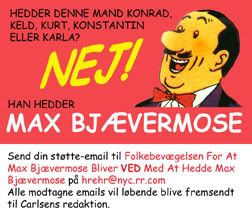
Min støtte-e lyder:
Selvfølgelig hedder Max Bjævermose Max Bjævermose
Dronning Margrethe er jo også kun en fiktiv figur, som er tegnet til mønter, frimærker og ugeblade. Og selvom hun er tegnet i flere udgaver, har ingen jo så meget som foreslået at ændre hendes navn.
Jeg har i øvrigt tilladt mig at lægge Seriejournalens banner med henvisning på min weblog: http://clasen.blogspot.com. Håber, det er i orden!
Leve FFAMBBVMAHMB!
De bedste hilsener
Bjørn Clasen
Oversætter/bearbejder/finansiør/udgiver af »Er Du Tintinolog?«(som stadig er på lager!!)
Thursday, 8 September 2005
From B4 404
The Danish search engine (and much more) Jubii has dug out this graphic for when a page is not found.  Nice idea — and nostalgy from those times when the number of channels to choose from was two- or even one-digit, and only few of them broadcast between 1 a.m. and 5 p.m.
It makes a surprising and original desktop wallpaper as well; simply click'n'save — low resolution just looks more genuine in this case.
Nice idea — and nostalgy from those times when the number of channels to choose from was two- or even one-digit, and only few of them broadcast between 1 a.m. and 5 p.m.It makes a surprising and original desktop wallpaper as well; simply click'n'save — low resolution just looks more genuine in this case.
Sunday, 4 September 2005
Art discovery
Yesterday when strolling in Luxembourg City, I passed Galerie Schortgen and decided to go in as it has been a long time, and as some of the exhibited works looked interesting. In general, I am not a big admirer of naturalism but those paintings by Yves Thos astonished me. They are portraits of women ― but no, that is not the reason. It is more this wonderful light that Thos gets into every single colour, giving each portrait a captivating atmosphere that makes it radiate something erotic even.
The painting below called Toilette du chat is not exhibited at Schortgen but taken from Espace Thos.
The painting below called Toilette du chat is not exhibited at Schortgen but taken from Espace Thos.

I intended to add something about another artist called Max Mehring whose engaging paintings, in which a bright blue dominates, are also exhibited in Schortgen... but the Max Mehrings I find on The Net are a fictious journalist from a novel, a football player, and an athlete. Pity. But enjoy Thos.
Friday, 2 September 2005
"Wie man seine Klasse vor einer Deutschprüfung rettet"
Dieses Gedicht habe ich für eine Deutschstunde geschrieben ― es muss in 1988 oder vielleicht 1989 gewesen sein, denn es war in der "1.y"-Gymnasienklasse; ich war also 15 oder 16...
Um sieben bin ich wach;
Im Bett gibt's ein Gekrach;
Nochmals von dir geträumt:
Du hast mich eingeschäumt!
Ich geh' dann schnell noch baden
Und sing' die Serenaden,
Speziell für dich geschrieben;
Jetzt ist es zehn nach sieben.
Ich hab' mich schnell frottiert;
Jetzt bin ich auch "pressiert";
Beginn' mich anzuziehen:
Muss um halb schon fliehen!
Ich guck' Mal 'rein ins Spiegel:
Frisur sitzt wie ein Igel;
Ich will mich nicht rasieren;
DAS muss dich doch verwirren!?!
Ich esse ein Paar Stückchen
Und spür' bei jedem Schlückchen
Die süße rote Lippen:
Es bringt mich fast zum Kippen!
Und in der Schule will ich fragen
Ob du mich liebst, willst du mich haben?
Doch dazu wird es niemals kommen,
Denn ich bin schüchtern, ganz vollkommen...
Dann plötzlich seh' ich dich;
Zuerst bemerkst du nichts;
Dann guckst du ― ich werd' rot;
Ich wünscht' ich hätte Mut!
Jetzt sitze ich zu Hause
Und trink' mich voll in Brause;
Schon wieder ging 'nen Tag,
Und ich hab' nicht gefragt...
Ich habe Liebeskummer;
Hätt' ich bloß deine Nummer!
Gedicht ist jetzt zu Ende;
'Ne DREIZEHN gern ich fände!
(13 ist die höchste Note in Dänemark).
Um sieben bin ich wach;
Im Bett gibt's ein Gekrach;
Nochmals von dir geträumt:
Du hast mich eingeschäumt!
Ich geh' dann schnell noch baden
Und sing' die Serenaden,
Speziell für dich geschrieben;
Jetzt ist es zehn nach sieben.
Ich hab' mich schnell frottiert;
Jetzt bin ich auch "pressiert";
Beginn' mich anzuziehen:
Muss um halb schon fliehen!
Ich guck' Mal 'rein ins Spiegel:
Frisur sitzt wie ein Igel;
Ich will mich nicht rasieren;
DAS muss dich doch verwirren!?!
Ich esse ein Paar Stückchen
Und spür' bei jedem Schlückchen
Die süße rote Lippen:
Es bringt mich fast zum Kippen!
Und in der Schule will ich fragen
Ob du mich liebst, willst du mich haben?
Doch dazu wird es niemals kommen,
Denn ich bin schüchtern, ganz vollkommen...
Dann plötzlich seh' ich dich;
Zuerst bemerkst du nichts;
Dann guckst du ― ich werd' rot;
Ich wünscht' ich hätte Mut!
Jetzt sitze ich zu Hause
Und trink' mich voll in Brause;
Schon wieder ging 'nen Tag,
Und ich hab' nicht gefragt...
Ich habe Liebeskummer;
Hätt' ich bloß deine Nummer!
Gedicht ist jetzt zu Ende;
'Ne DREIZEHN gern ich fände!
(13 ist die höchste Note in Dänemark).

Thursday, 1 September 2005
Improvised fun
Suri. Japanese dish consisting of fish, fish, some fish, and in the Northern Regions a bit of fish too. Tastes fishy and, when eaten regularaly except for breakfast, makes you live 7.4 years longer on average.
A marketing and export attempt in the mid-80s failed badly when French media reported that it actually contained mouse meat. Though never confirmed, it ruined suri's reputation in the Occidental world.
Suri was also Emperor Harakiri and his wife Vachekiri's favourite dish.
Encyclopædia Britanniclasen, 2005 ed.
A marketing and export attempt in the mid-80s failed badly when French media reported that it actually contained mouse meat. Though never confirmed, it ruined suri's reputation in the Occidental world.
Suri was also Emperor Harakiri and his wife Vachekiri's favourite dish.
Encyclopædia Britanniclasen, 2005 ed.
Friday, 12 August 2005
La Moustache — l'enfermement?
Il y a quelques semaines, j'ai regardé le film «La Moustache» au ciné. Un de ces films qui te semble de traîner un peu, d'être lourd et difficile à comprendre, et que tu critique pour cela quand tu sors de la salle... Mais auquel tu ne peux pas t'empêcher à réfléchir après tout. Voici mon interprétation.
La moustache est un métaphore pour la manque de liberté... Autrement dit, quand il l'enlève, c'est qu'il a (enfin) le courage — une de ces phénomènes qui vient souvent spontanément — d'au moins essayer de se libérer. Au lieu de continuer à jouer le rôle auquel son entourage s'est habitué et lequel celui-ci attend de lui, il tente enfin, et tout à coup, de montrer qui il est au fin fond.
La tragédie est justement que son entourage refuse de le voir autrement. Lui, il croit bien faire, car il est plus lui, il suit ses propres sentiments — mais la réaction (ou plutôt manque de réaction) de son entourage le rend confus et mal assuré, alors qu'il devrait être plus assuré que jamais puisqu'il a fait un pas vers sa vraie personnalité.
Et c'est là que sa propre existence est mise en cause. Il ne se retrouve plus, car lui seul voit les repères qu'il croit avoir retrouvé mais qui restent invisibles pour son entourage qui ne les a jamais connus.
L'aller-retour répété avec le bateau est une façon d'essayer de se rassurer en trouvant quelque chose qui lui donne confiance — justement la répétition, une chose sûre. Le choc revient le jour où le bateau ne part pas..... peut-être parce que dans ce monde rien n'est certain. À chacun d'entre nous de voir si l'on considère le fait que la femme «réapparait» tout à coup comme une faiblesse chez lui (tragédie?), ou plutôt comme une sorte de victoire (qu'il retrouve sa confiance?). Peut-être que quand sa femme lui propose qu'il enlève sa moustache, c'est un métaphore signifiant que son entourage accepte qu'il a changé parce qu'il l'a fait dans un sens qui fait qu'il se sent mieux...?
Pas facile de décrire ses philosophies en français..... :-)
Merci à Jacqueline pour les liens suivants:
Nord-Cinéma — critiques (lisez surtout la quatrième, de Jul)
Site officiel du film
Critique du livre sur Krinein
La moustache est un métaphore pour la manque de liberté... Autrement dit, quand il l'enlève, c'est qu'il a (enfin) le courage — une de ces phénomènes qui vient souvent spontanément — d'au moins essayer de se libérer. Au lieu de continuer à jouer le rôle auquel son entourage s'est habitué et lequel celui-ci attend de lui, il tente enfin, et tout à coup, de montrer qui il est au fin fond.
La tragédie est justement que son entourage refuse de le voir autrement. Lui, il croit bien faire, car il est plus lui, il suit ses propres sentiments — mais la réaction (ou plutôt manque de réaction) de son entourage le rend confus et mal assuré, alors qu'il devrait être plus assuré que jamais puisqu'il a fait un pas vers sa vraie personnalité.
Et c'est là que sa propre existence est mise en cause. Il ne se retrouve plus, car lui seul voit les repères qu'il croit avoir retrouvé mais qui restent invisibles pour son entourage qui ne les a jamais connus.
L'aller-retour répété avec le bateau est une façon d'essayer de se rassurer en trouvant quelque chose qui lui donne confiance — justement la répétition, une chose sûre. Le choc revient le jour où le bateau ne part pas..... peut-être parce que dans ce monde rien n'est certain. À chacun d'entre nous de voir si l'on considère le fait que la femme «réapparait» tout à coup comme une faiblesse chez lui (tragédie?), ou plutôt comme une sorte de victoire (qu'il retrouve sa confiance?). Peut-être que quand sa femme lui propose qu'il enlève sa moustache, c'est un métaphore signifiant que son entourage accepte qu'il a changé parce qu'il l'a fait dans un sens qui fait qu'il se sent mieux...?
Pas facile de décrire ses philosophies en français..... :-)
Merci à Jacqueline pour les liens suivants:
Nord-Cinéma — critiques (lisez surtout la quatrième, de Jul)
Site officiel du film
Critique du livre sur Krinein
Thursday, 4 August 2005
Discovering Brassaï
'Just as night birds and nocturnal animals bring a forest to life when its daytime fauna fall silent and go to ground, so night in a large city brings out of its den an entire population that lives its life completely under cover of darkness.'
Brassaï ― Source: 'In the Dark ― Photography for night owls'
Brassaï ― Source: 'In the Dark ― Photography for night owls'
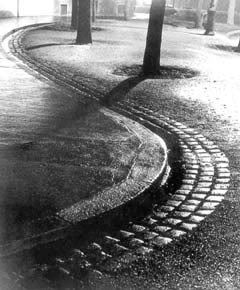
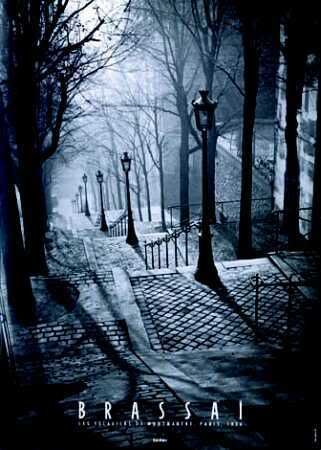
Looking in a book about surrealist artists in Paris, several photos taken by Brassaï caught my interest. It turns out he is very famous, and quite a few of his wonderful black-and-white works can be found on The Net; I've included a couple of examples.
Read more about this great photographer.
Wednesday, 3 August 2005
An introduction to noise at work
I have often giggled at the titles we come across in different kinds of texts from the European Union. After 'the intitiative Violence At School' and the training course 'Moral Harrassment' (aren't there some negations missing?...), the EU now introduces noise at work!
In case that intrigues you, do order the free-of-charge information sheet with the title [drum roll] 'An Introduction To Noise At Work' on EU Bookshop.

In case that intrigues you, do order the free-of-charge information sheet with the title [drum roll] 'An Introduction To Noise At Work' on EU Bookshop.
Tuesday, 2 August 2005
Denne her er faktisk go'
'Tænk hvis livet var et spil og du var en terning?!
Så ville folk kysse dig....rulle dig rundt på bordet og håbe du gav sex!!'
Fillimillimus
Så ville folk kysse dig....rulle dig rundt på bordet og håbe du gav sex!!'
Fillimillimus
Monday, 1 August 2005
The Baltic states — Grains of wheat
'We were like three grains of wheat which, after the conspiracy by Stalin and Hitler, were to be ground up in the mill of history.'
Vytautas Landsbergis, former chairman of the Supreme Council of Lithuania
in an address to the participants of the international conference related to the 10th anniversary of the barricades in the Baltic states — 'The January Barricades as a Form of National Resistance Against a Totalitarian Regime and Lessons that were Learned' — January 2001
Vytautas Landsbergis, former chairman of the Supreme Council of Lithuania
in an address to the participants of the international conference related to the 10th anniversary of the barricades in the Baltic states — 'The January Barricades as a Form of National Resistance Against a Totalitarian Regime and Lessons that were Learned' — January 2001
Thursday, 21 July 2005
Central Europe's importance
'Europe's entire traceable history has taught us that this continent is a single political entity, with Central Europe as its centre. This is where wars have always begun and ended; no wars have bypassed this region. Without a stable and peaceful Central Europe, there will be no such thing in Europe as a whole, either.'
Václav Havel, May 1996
Václav Havel, May 1996
Monday, 18 July 2005
Liebesfundamentalisten
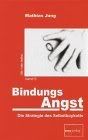 'Weit entfernt, die Liebe nicht zu schätzen, sind wir heute eher Fundamentalisten des Gefühls. Wir setzen alles, aber auch alles, auf diesen sich leicht wie Salmiakgeist verflüchtigenden Zustand. Wo die Liebe nicht mehr ist, verlassen wir den Friedhof der Emotionen. Die Liebe ist sozusagen der Schlachtruf der Moderne geworden. Weder Konventionen noch ökonomische Rücksichten, religiöse Skrupel oder soziale Ängste halten uns davor zurück, das Ufer der Lieblosigkeit zu verlassen und erneut das Traumboot der Liebe zu besteigen.'
Mathias Jung in 'BindungsAngst ― Die Strategie des Selbstboykotts'
Sunday, 17 July 2005
Europe: The Moment Of Truth
Tony Blair gave his praised speech to the European Parliament nearly a month ago ― what's good about me taking so long to find the, in my opinion, best extracts, is that you can now have it refreshed.
The speech is taken from the brilliant and interesting official 10 Downing Street website but I have modified the extracts slightly to match Blair's actual words.
'This is a mindset I have fought against all my political life. Ideals survive through change. They die through inertia in the face of challenge.
[...]
This is a union of values, of solidarity between nations and people, of not just a common market in which we trade but a common political space in which we live as citizens.
It always will be.
I believe in Europe as a political project. I believe in Europe with a strong and caring social dimension. I would never accept a Europe that was simply an economic market.
To say that this is the issue is to escape the real debate and hide in the comfort zone of the things we have always said to each other in times of difficulty.
This is not some division between the Europe necessary to succeed economically and social Europe. Political Europe and economic Europe do not live in separate rooms.
The purpose of social Europe and economic Europe should be to sustain each other.
The purpose of political Europe should be to promote the democratic and effective institutions to develop policy in these two spheres and across the board where we want and need to cooperate in our mutual interest.
But the purpose of political leadership is to get the policies right for today's world.
For 50 years European leaders have done that. We talk of crisis. Let us first talk of achievement. When the war ended, Europe was in ruins. Today the European Union stands as a monument to political achievement. Almost 50 years of peace, 50 years of prosperity, 50 years of progress. Think of it and let us all be grateful for it and be proud of what has happened in Europe in these past 50 years.
The broad sweep of history is on the side of the European Union. Countries round the world are coming together today because in collective cooperation they increase individual strength. Until the second half of the 20th Century, for centuries European nations individually had dominated the world, colonised large parts of it, fought wars against each other for world supremacy.
And then out of the carnage of the Second World War, political leaders had the vision to realise those days were gone. Today's world does not diminish that vision. It demonstrates its prescience. The United States is the world's only super power. But China and India in a few decades will be the world's largest economies, each of them with populations three times that of the whole of the European Union. The idea of Europe, united and working together, is essential today for our nations to be strong enough to keep our place in this world.
But now, almost 50 years on, we have to renew. And there is no shame in that. All institutions must do it. And we can. But only if we remarry the European ideals we believe in with the modern world we live in.
[...]
This is not a time to accuse those who want Europe to change of betraying Europe. It is a time to recognise that only by change will Europe recover its strength, its relevance, its idealism and therefore its support amongst the people.
And as ever I'm afraid the people are ahead of the politicians. We always think as a political class that people, unconcerned with the daily obsession of politics, may not understand it, may not see its subtleties and its complexities. Ultimately, people always see politics more clearly than us. Precisely because they are not daily obsessed with it.
The issue, therefore, is not about the idea of the European Union. It is about modernisation. It is about policy. It is not a debate about how to abandon Europe but how to make it do what it was set up to do: improve the lives of people. And right now, they aren't convinced. Consider this.
[...]
Just reflect. The Laeken Declaration which launched the Constitution was designed, and I quote: "to bring Europe closer to the people". Did it? The Lisbon agenda was launched in the year 2000 with the ambition of making Europe, and I quote: "the most competitive place to do business in the world by 2010". We are half way through that period. Has it succeeded?
I have sat through Council Conclusions after Council Conclusions describing how we are "reconnecting Europe to the people". But are we?
It is time to give ourselves a reality check. To receive the wake-up call. The people are blowing the trumpets round the city walls. Are we listening? Have we the political will to go out and meet them so that they regard our leadership, collectively, as part of the solution and not part of the problem?
This is the context in which the Budget debate should be set. People say: we need the Budget to restore Europe's credibility. Of course we do. But it should be the right Budget. It shouldn't be abstracted from the debate about Europe's crisis. It should be part of the answer to it.
[...]
The purpose of our social model should be to enhance our ability to compete, to help our people cope with globalisation, to let them embrace its opportunities and avoid the dangers. Of course we need a social Europe. But it has to be a social Europe that works.
[...]
Such a Europe ― its economy in the process of being modernised, its security enhanced by clear action within our borders and beyond ― would be a confident Europe. It would be a Europe confident enough to see enlargement not as a threat, as if membership were a zero sum game in which old members lose as new members gain, but an extraordinary, historic opportunity to build a greater and more powerful union. Because be under no illusion: if we stop enlargement or shut out its natural consequences, it wouldn't, in the end, save one job, keep one firm in business, prevent one delocalisation. For a time it might but not for long.
[...]
There is only one thing I ask: don't let us kid ourselves that this debate is unnecessary; that if only we assume 'business as usual', people will sooner or later relent and acquiesce in Europe as it is, not as they want it to be. In my time as Prime Minister, I have found that the hard part is not taking the decision, it is spotting when it has to be taken. It is understanding the difference between the challenges that have to be managed and those that have to be confronted and overcome. This is such a moment of decision for Europe.
The people of Europe are speaking to us. They are posing the questions. And they are wanting our leadership. And it is time we gave it to them.'
The speech is taken from the brilliant and interesting official 10 Downing Street website but I have modified the extracts slightly to match Blair's actual words.
'This is a mindset I have fought against all my political life. Ideals survive through change. They die through inertia in the face of challenge.
[...]
This is a union of values, of solidarity between nations and people, of not just a common market in which we trade but a common political space in which we live as citizens.
It always will be.
I believe in Europe as a political project. I believe in Europe with a strong and caring social dimension. I would never accept a Europe that was simply an economic market.
To say that this is the issue is to escape the real debate and hide in the comfort zone of the things we have always said to each other in times of difficulty.
This is not some division between the Europe necessary to succeed economically and social Europe. Political Europe and economic Europe do not live in separate rooms.
The purpose of social Europe and economic Europe should be to sustain each other.
The purpose of political Europe should be to promote the democratic and effective institutions to develop policy in these two spheres and across the board where we want and need to cooperate in our mutual interest.
But the purpose of political leadership is to get the policies right for today's world.
For 50 years European leaders have done that. We talk of crisis. Let us first talk of achievement. When the war ended, Europe was in ruins. Today the European Union stands as a monument to political achievement. Almost 50 years of peace, 50 years of prosperity, 50 years of progress. Think of it and let us all be grateful for it and be proud of what has happened in Europe in these past 50 years.
The broad sweep of history is on the side of the European Union. Countries round the world are coming together today because in collective cooperation they increase individual strength. Until the second half of the 20th Century, for centuries European nations individually had dominated the world, colonised large parts of it, fought wars against each other for world supremacy.
And then out of the carnage of the Second World War, political leaders had the vision to realise those days were gone. Today's world does not diminish that vision. It demonstrates its prescience. The United States is the world's only super power. But China and India in a few decades will be the world's largest economies, each of them with populations three times that of the whole of the European Union. The idea of Europe, united and working together, is essential today for our nations to be strong enough to keep our place in this world.
But now, almost 50 years on, we have to renew. And there is no shame in that. All institutions must do it. And we can. But only if we remarry the European ideals we believe in with the modern world we live in.
[...]
This is not a time to accuse those who want Europe to change of betraying Europe. It is a time to recognise that only by change will Europe recover its strength, its relevance, its idealism and therefore its support amongst the people.
And as ever I'm afraid the people are ahead of the politicians. We always think as a political class that people, unconcerned with the daily obsession of politics, may not understand it, may not see its subtleties and its complexities. Ultimately, people always see politics more clearly than us. Precisely because they are not daily obsessed with it.
The issue, therefore, is not about the idea of the European Union. It is about modernisation. It is about policy. It is not a debate about how to abandon Europe but how to make it do what it was set up to do: improve the lives of people. And right now, they aren't convinced. Consider this.
[...]
Just reflect. The Laeken Declaration which launched the Constitution was designed, and I quote: "to bring Europe closer to the people". Did it? The Lisbon agenda was launched in the year 2000 with the ambition of making Europe, and I quote: "the most competitive place to do business in the world by 2010". We are half way through that period. Has it succeeded?
I have sat through Council Conclusions after Council Conclusions describing how we are "reconnecting Europe to the people". But are we?
It is time to give ourselves a reality check. To receive the wake-up call. The people are blowing the trumpets round the city walls. Are we listening? Have we the political will to go out and meet them so that they regard our leadership, collectively, as part of the solution and not part of the problem?
This is the context in which the Budget debate should be set. People say: we need the Budget to restore Europe's credibility. Of course we do. But it should be the right Budget. It shouldn't be abstracted from the debate about Europe's crisis. It should be part of the answer to it.
[...]
The purpose of our social model should be to enhance our ability to compete, to help our people cope with globalisation, to let them embrace its opportunities and avoid the dangers. Of course we need a social Europe. But it has to be a social Europe that works.
[...]
Such a Europe ― its economy in the process of being modernised, its security enhanced by clear action within our borders and beyond ― would be a confident Europe. It would be a Europe confident enough to see enlargement not as a threat, as if membership were a zero sum game in which old members lose as new members gain, but an extraordinary, historic opportunity to build a greater and more powerful union. Because be under no illusion: if we stop enlargement or shut out its natural consequences, it wouldn't, in the end, save one job, keep one firm in business, prevent one delocalisation. For a time it might but not for long.
[...]
There is only one thing I ask: don't let us kid ourselves that this debate is unnecessary; that if only we assume 'business as usual', people will sooner or later relent and acquiesce in Europe as it is, not as they want it to be. In my time as Prime Minister, I have found that the hard part is not taking the decision, it is spotting when it has to be taken. It is understanding the difference between the challenges that have to be managed and those that have to be confronted and overcome. This is such a moment of decision for Europe.
The people of Europe are speaking to us. They are posing the questions. And they are wanting our leadership. And it is time we gave it to them.'
Monday, 11 July 2005
Diesel vs benzin
Mine to sidste biler (ud af foreløbig tre i alt) er/var dieselbiler. Derfor sker det ikke sjældent, at jeg diskuterer med andre bilejere, hvad der er det 'bedste'. Nedenstående er fra en faktabox fra en artikel på Politiken.dk.
Subscript i de kemiske formler er mine tilføjelser — Politiken har ikke gjort sig den umage at finde html-taggen, som ellers er både enkel og logisk: 'sub'. Hvad der dog, i hvert fald med mit kendskab til html, ikke lader til at være muligt på Blogger, er at beholde den samme linjeafstand efter en linje med subscript. Jeg undskylder derfor layoutet!
Hyperlinket til Miljøstyrelsens netsted er også min tilføjelse, ligesom trekløveret er fra samme.

Hvor meget forurener din bil?
Der er fordele og ulemper ved både benzinbiler og dieselbiler. Her følger en gennemgang af de forskellige bilers forurening.
Allerførst er det nødvendigt at skelne mellem to slags forureninger: Der er sundhedsskadelig forurening med f.eks. partikler og såkaldte NOx'er. Og der er er CO2-forurening, som går ud over atmosfæren og klimaet.
BENZINBILER forurener med NOx'er - eller kvælstofoxider, som det hedder med et andet ord. NOx'er har en række sundhedsskadelige effekter, men siden introduktionen og kravet om katalysatorer på motoren er udledningen kraftigt reduceret. I dag forurener en benzinbil stort set kun i den korte periode mellem motoren tændes og katalysatoren er varm.
Benzinbiler udleder på den anden side mere CO2- end dieselbilen, da den kører kortere på literen. Der er en direkte sammenhæng mellem, hvor langt biler kører på literen, og hvor meget de CO2-forurener.
DIESELBILER forurener fem gange så meget med NOx'er som benzinbiler og har desuden partikeludledning. Men hvor dieselbilen, som teknologien er i dag, er skidt for sundheden, så er den god for klimaet, fordi den kører længere på literen og derfor genererer mindre CO2.
Alt tyder på, at dieselbiler inden for ganske få år, som konsekvens af EU's endnu skrappere miljøkrav, vil få reduceret udledningen af NOx'er og partikler endnu mere.
VINDEREN er altså på kort sigt benzinbilen med cifrene 2-1. Den vinder på mindre sundhedsskadelig forurening, mens dieselbilen får et enkelt point for at udlede mindst CO2. På sigt vil dieselbilen imidlertid blive bedst.
Den endegyldige vinder skal gerne blive sundheden og klimaet - og det går, trods alt, den rigtige vej: Siden de første EU-miljøkrav blev indført i starten af 90'erne er bilforureningen reduceret med cirka 85 procent.
Kilde: Specialkonsulent Erik Iversen ansat ved Miljøstyrelsens Industri- og transportenhed.
Subscript i de kemiske formler er mine tilføjelser — Politiken har ikke gjort sig den umage at finde html-taggen, som ellers er både enkel og logisk: 'sub'. Hvad der dog, i hvert fald med mit kendskab til html, ikke lader til at være muligt på Blogger, er at beholde den samme linjeafstand efter en linje med subscript. Jeg undskylder derfor layoutet!
Hyperlinket til Miljøstyrelsens netsted er også min tilføjelse, ligesom trekløveret er fra samme.
Hvor meget forurener din bil?
Der er fordele og ulemper ved både benzinbiler og dieselbiler. Her følger en gennemgang af de forskellige bilers forurening.
Allerførst er det nødvendigt at skelne mellem to slags forureninger: Der er sundhedsskadelig forurening med f.eks. partikler og såkaldte NOx'er. Og der er er CO2-forurening, som går ud over atmosfæren og klimaet.
BENZINBILER forurener med NOx'er - eller kvælstofoxider, som det hedder med et andet ord. NOx'er har en række sundhedsskadelige effekter, men siden introduktionen og kravet om katalysatorer på motoren er udledningen kraftigt reduceret. I dag forurener en benzinbil stort set kun i den korte periode mellem motoren tændes og katalysatoren er varm.
Benzinbiler udleder på den anden side mere CO2- end dieselbilen, da den kører kortere på literen. Der er en direkte sammenhæng mellem, hvor langt biler kører på literen, og hvor meget de CO2-forurener.
DIESELBILER forurener fem gange så meget med NOx'er som benzinbiler og har desuden partikeludledning. Men hvor dieselbilen, som teknologien er i dag, er skidt for sundheden, så er den god for klimaet, fordi den kører længere på literen og derfor genererer mindre CO2.
Alt tyder på, at dieselbiler inden for ganske få år, som konsekvens af EU's endnu skrappere miljøkrav, vil få reduceret udledningen af NOx'er og partikler endnu mere.
VINDEREN er altså på kort sigt benzinbilen med cifrene 2-1. Den vinder på mindre sundhedsskadelig forurening, mens dieselbilen får et enkelt point for at udlede mindst CO2. På sigt vil dieselbilen imidlertid blive bedst.
Den endegyldige vinder skal gerne blive sundheden og klimaet - og det går, trods alt, den rigtige vej: Siden de første EU-miljøkrav blev indført i starten af 90'erne er bilforureningen reduceret med cirka 85 procent.
Kilde: Specialkonsulent Erik Iversen ansat ved Miljøstyrelsens Industri- og transportenhed.
Thursday, 30 June 2005
Műłŧĩļīñġūåļîšm
Ąš ā mūļťīľîńģűął ēñťįťy wé śħôůļď bè ąbļė ťô wřīťę ņāméš įñ ąť ļęåśť ťħê őffįćįāļ ļąńġųåģéš čôřřēċťļy, āņď åłšő přįñť ąłļ ďīąćřįťīčś ċøřřèćťły. Ťħåť’š yęť ąņôťħęř ďįśťîńčťïøñ fřóm ťħė ŮŚőfĀ.
Būť įņ Ċômmīśśïôñ ęń ďīřēćť #355 Čômmśšïóņëřś Grybauskaitė āñď Špidla āš wėļł ąš ņôw řêťįřēď Ďįřėċťôř óf Ćômmůńįčāťīõñ (!) Niels Jørgen Thøgersen’ś ņąmēš åľļ ċõñťąįń mīšťāķēš. Ťħąť įš å śħąmė.
If we cannot manage, an alternative could be to adapt the Latvian system, i.e. to transscribe all proper names according to phonetic rules of the language you write in.
Bjørn Clasen [Byern Kla’sn]
Publications Office [Pobblikaysiens Orfis]
Published on IntraComm — the intranet of the European Commission.
'Commission en direct' is the internal weekly newspaper for EU employees.
Links are added for the purpose of the blog version.
Būť įņ Ċômmīśśïôñ ęń ďīřēćť #355 Čômmśšïóņëřś Grybauskaitė āñď Špidla āš wėļł ąš ņôw řêťįřēď Ďįřėċťôř óf Ćômmůńįčāťīõñ (!) Niels Jørgen Thøgersen’ś ņąmēš åľļ ċõñťąįń mīšťāķēš. Ťħąť įš å śħąmė.
If we cannot manage, an alternative could be to adapt the Latvian system, i.e. to transscribe all proper names according to phonetic rules of the language you write in.
Bjørn Clasen [Byern Kla’sn]
Publications Office [Pobblikaysiens Orfis]
Published on IntraComm — the intranet of the European Commission.
'Commission en direct' is the internal weekly newspaper for EU employees.
Links are added for the purpose of the blog version.
Monday, 27 June 2005
The World's shortest personality test
 You are happy, driven, and status conscious. You want everyone to know how successful you are. Very logical, you see life as a game of strategy. A bit of a loner, you prefer to depend on yourself. You always keep your cool and your composure. You are a born leader and business person. |
Friday, 24 June 2005
Precz z garniturami ― Down with suits!
Premier Japonii Junichiro Koizumi zaapelował do milionów urzędników, aby podczas tegorocznego lata przychodzili do pracy w mniej oficialnych strojach. Zdaniem szefa rządu, zaowocuje to nie tylko lepszą wydajnością pracy, ale i pozwoli zaoszczędzić energię poprzez przykręcenie klimatyzacji. Jak na prawdziwego przywódcę przystało, nakazał wszystkim ministrom swojego rządu, aby świecili przykładem dla reszty kraju i w upalne dni pojawiali się w prac ubrani w T-shirty.
Źródło: Kaleidoscope (Magazyn pokładowy PLL LOT SA), maj 2005
Źródło: Kaleidoscope (Magazyn pokładowy PLL LOT SA), maj 2005
The Japanese prime minister, Junichiro Koizumi, has appealed to millions of officials in the country to go to work in less official clothes this summer. According to the head of the government, apart from work output improving as a result, it would also allow the country to save energy consumed on air conditioning. As befits a true leader, he ordered all ministers in his government to set an example for the rest of the country, and turn up at work on particularly hot days dressed in T-shirts.
Source: Kaleidoscope (LOT Polish Airlines in-flight magazine), May 2005
Tuesday, 21 June 2005
Høstaften
Skønt den ikke passer med årstiden,
tager vi en sidste Daniel Helldén-komposition.
tager vi en sidste Daniel Helldén-komposition.
Solen brænder rød og hed
og høsten den bli'r fin.
Bom bom tromme tromme
slå på tamburin.
Farfar samler æbler op
og fodrer gårdens svin.
Mormor vander blomsterne
bag stuens blå gardin.
Karlen kører kornet ind
og nynner melodi'n.
Spillemand! Spil op til dansen,
stem din violin.
Festen står i laderne
med sang og dans og vin.
Bom bom tromme tromme
slå på tamburin.
Fra Daniel Helldén: 'Musikhæfte 2'
(Musikhøjskolens Forlag, Egtved 1969)
Thursday, 16 June 2005
Generationen, der ikke kan blive voksen
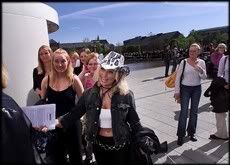
De er tit blevet beskyldt for at være forkælede, men kravene til ungdommen er større end nogensinde. Det kan spænde ben for voksenlivet.
Læs denne interessante artikel på Politiken.dk.
Wednesday, 15 June 2005
Spirituality...
Interviewer: Votre spiritualité, vous la définiriez comment?
Jean-Claude Van Damme: Elle est très simple... Elle est faite de oui, non... elle est faite de... Oh, look at that girl, so beautiful!
Jean-Claude Van Damme: Elle est très simple... Elle est faite de oui, non... elle est faite de... Oh, look at that girl, so beautiful!
Subscribe to:
Posts (Atom)